Most people preparing for the GRE are already grinding. Four hours a day, a thousand questions deep, and the score still won't move. You find out on test day, when it's too late to change anything. More hours won't move it. A system will, built around the one thing nobody teaches: reflecting on the right mistakes. I scored 335 that way, and below I'll show you how it works.
Every student I talk to says a version of the same thing. See if any of these hit close to home.
That's where I was too. One thing matters more than the rest:
You are not stupid. You are not lazy. You are working hard.
The problem is that "doing more questions" is not a strategy. It's a treadmill. You can run on it for six months and your score won't move an inch. That's not your fault. It's what happens when you put in effort without a system.
What works is short, focused, and a bit boring: diagnose where you're losing points, reflect on every mistake until you see the pattern, drill the weakness, then move on. That's the whole game.
I scored 146 on Verbal the first time I took the GRE. The bare minimum my program needed. I'd studied every evening for a month: grinding questions, glancing at the answer key when I got one wrong, moving on. I thought effort was the whole game. It wasn't. I walked out with a score I was too embarrassed to say out loud for the next five years.
When I came back to the GRE for an MBA, I couldn't afford another 146. So I threw out the "more questions" approach and rebuilt how I studied around one idea: the score doesn't move when you do more, it moves when you stop repeating the same mistakes. I started logging every one. For each wrong answer: the question type, why I got it wrong, and the one fix. I reviewed that log until the patterns burned into my head and I stopped walking into the same traps.
Two months later, working full-time, non-native English: 165 Verbal, 170 Quant. 335 total.
When I saw that number on the screen at the end of the test, I almost cried. I sat there until a staff member walked over and said, "You've completed the exam. You're free to leave."
That error log became the core of a method: diagnose the real weakness, reflect on every mistake until the pattern is obvious, drill that thing, move on. It isn't glamorous and it isn't fast-food advice. It's the thing that works, and almost nobody does it because doing it alone is exhausting.
That's why I do this now. I teach the method 1-on-1 to a small number of students, and I built a platform that runs the reflection system for them: logging errors, surfacing patterns, telling them what to work on each day. They skip the part that made me want to quit. I'd rather hand you the system than watch you lose the months I lost.
I gave away my whole 60-day plan, and I mean it. Follow it and you'll be ahead of most people grinding without direction. But a plan is a map. It doesn't know you. It can't see the spot where your reasoning breaks, because that spot is invisible from the inside. You've been looking at it the whole time without seeing it. That's what makes it a blind spot.
Almost nobody tells you the hard part of GRE prep. It isn't learning the material. It's diagnosing your own mistakes. You get a question wrong and you have to decide: was that a vocab gap? A logic gap? Did I misread the scope, or not know the concept? Get the diagnosis wrong and you fix the wrong thing. You drill vocab when your real problem was directionality, and the score sits still no matter how many hours you put in.
Doing that alone is brutal. The problem isn't difficulty. You're never sure you got it right. You spend an hour on one question with no one to sanity-check your logic, no idea whether the pattern you see is the real one. Most people quit here. Reviewing your own mistakes alone, with no one to confirm you're on the right track, drains you in a way no one warns you about.
That's what I do. I sit on the other side of your mistakes and name the pattern you can't see, often inside the first handful of errors. It took me two months to work mine out alone the second time, after a failed first attempt. With someone who has walked through these traps, that compresses into two or three sessions instead of two or three months. If your test is close, that's the whole difference.
So where does the platform come in? The platform is the tool you use every day. It logs your errors, sorts them by pattern, gives you hints, builds your daily plan. It's the reflection system I used to score 335, turned into software. A tool doesn't set itself up though. I read your diagnostic, tell you how you should study, and catch what the tool can't. The platform runs the system. I make sure it's the right system for you.
Your first session is built around your score, your weak spots, and your deadline. No generic curriculum. Only what moves your score, with a concrete outcome attached to each piece.
Book your first sessionMost prep tools hand you more content. This one looks at what you've already gotten wrong and tells you the one thing to do next.
It logs every question you miss and sorts it by pattern (vocab gap, concept gap, careless slip) so you see the shape of your mistakes instead of feeling them. When you're stuck, a hint unlocks your thinking step by step without handing you the answer. It builds a daily plan from your own error data, so you never open it wondering what to work on. It runs full timed mocks that anchor a predicted score and track it over time, so you watch the needle move.
What students say about the platform
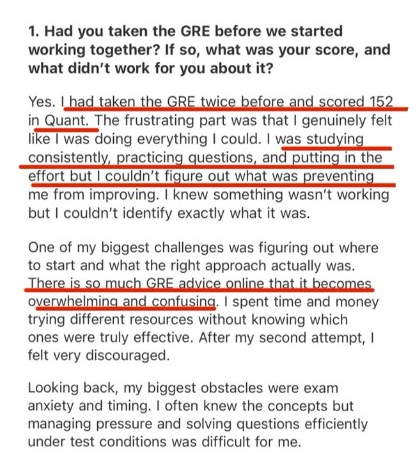
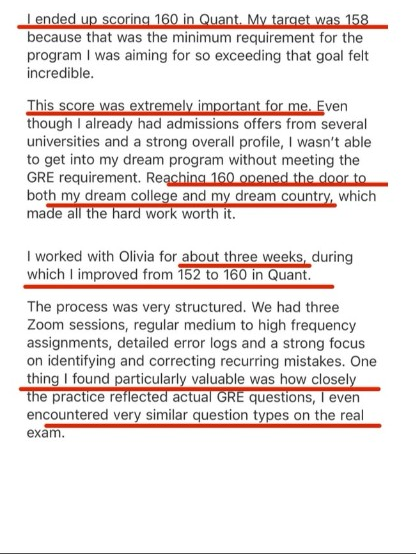
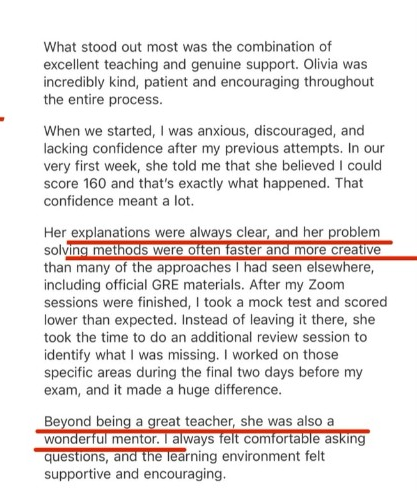
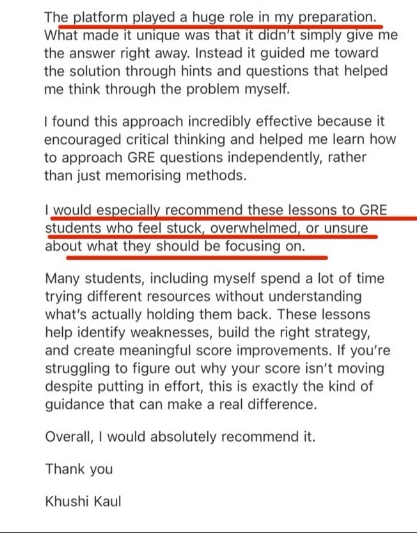
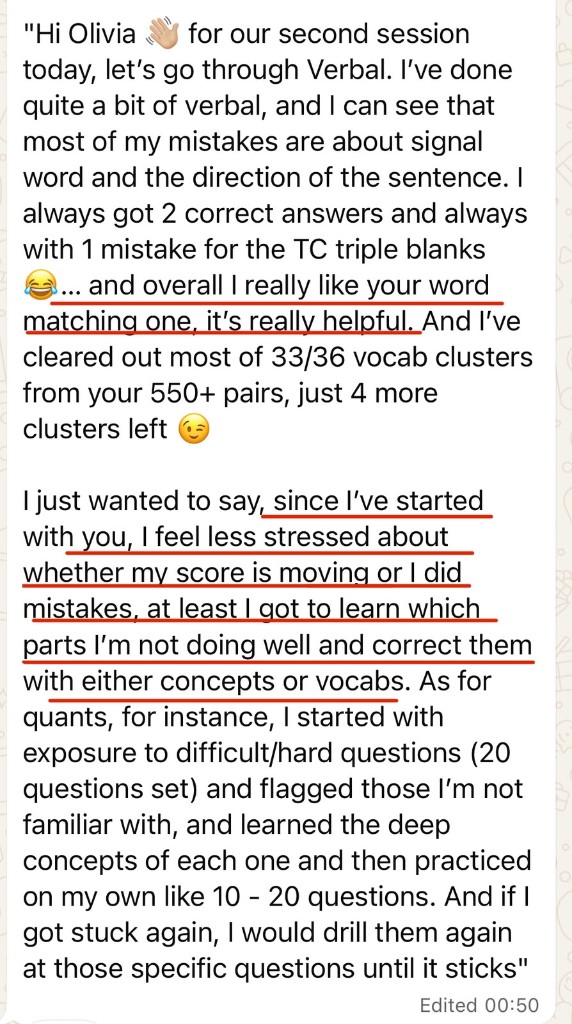
"Since I started with you, I feel less stressed about whether my score is moving or if I made mistakes. At least I get to learn which parts I'm not doing well and correct them, with either concepts or vocab. I really like your word-matching one, it's really helpful."
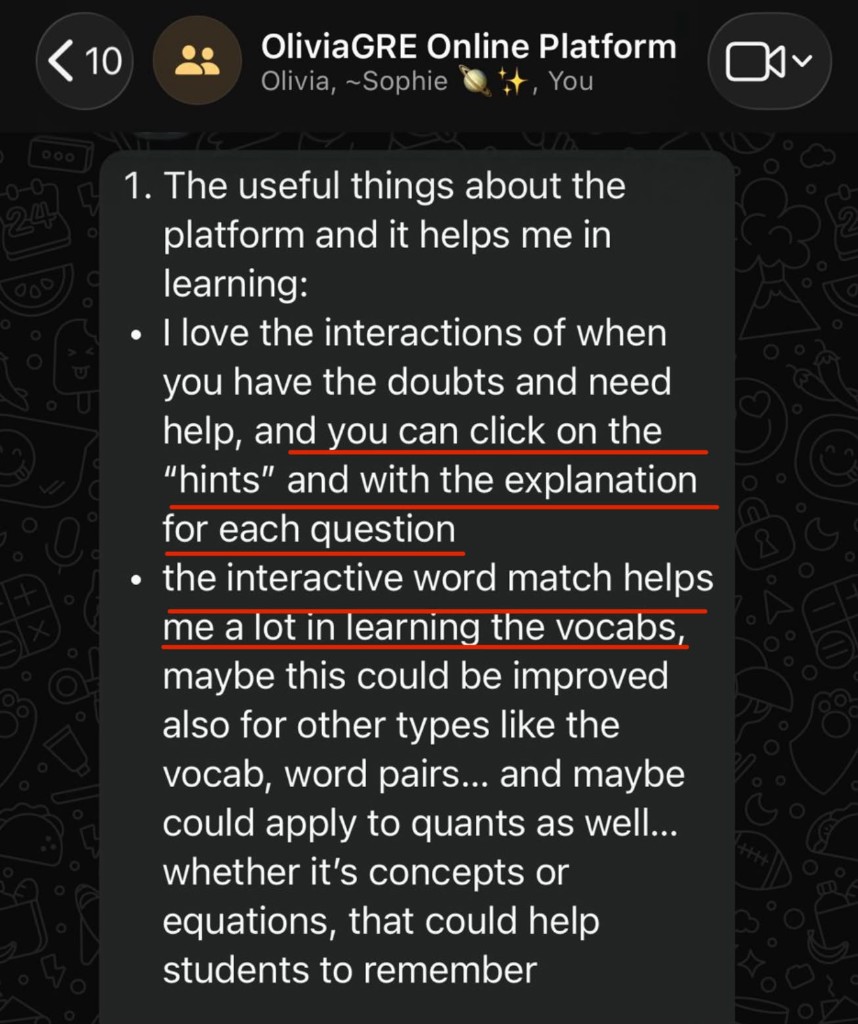
"I love the interaction. When you have doubts and need help, you can click the hint and get the explanation for each question. The interactive word match helps me a lot in learning the vocab."
On its own a 325 means little. It buys you a different next five years. Before we talk study plans, let's talk about why you're doing this.
You've spent twenty minutes staring at the screen, shaking a little. You pull out your phone in the parking lot.
That text is your first proof that the last few months weren't wasted. You didn't "study a lot." You did the thing.
You read it three times to make sure it's real. You forward it to your mom. The program you were quietly hoping for, the one you weren't sure you were good enough for, said yes.
You look around the lecture hall and it hits you: these are your peers now, your network for the next thirty years.
The career change you'd been quietly thinking about isn't a fantasy anymore. It's your life now.
We're not chasing a 325 because the number is pretty.
We're chasing it because of the school you walk into, the career door it opens, and the version of you that gets to exist on the other side of test day.
Everything starts with one session. You book, you get the platform, you take the diagnostic, and I build that first hour on your real mistakes before we meet.
You take the diagnostic. It surfaces your real error patterns, and I study them ahead of our hour, so nothing gets wasted on discovery.
We work through your mistakes live. I watch how you think, not only whether you get it right, and I name the pattern costing you points. Most people get a clear "oh" moment here.
You leave with specific changes to make this week and the platform to run them on. You drill your weak spots on your own time, with the error log tracking whether they improve. You also get a straight read on what working together longer would look like, mapped to your test date. If ongoing tutoring fits, I'll say so. If it doesn't, I'll tell you that too.
This isn't a sample call where I look at you cold and improvise. You book and pay, then pick the soonest time that fits. The moment you're in, you get the platform, and you take the diagnostic that surfaces your error patterns. I take your real mistakes, not a generic profile, and build your session around them before we get on the call.
When we meet, I'm not starting from zero. I know where you're leaking points, and we spend the full 60 minutes on your patterns instead of warming up. You walk out having started to fix the thing holding your score down. The platform stays yours for two weeks, the same one my students use to prep, and if we keep working together, you keep it for the whole time.
The real value of this session isn't the hour or the price. It's that you walk out knowing what's been costing you points, your error patterns named, instead of guessing.
That one thing changes everything downstream. Most people who study for months and still miss their target aren't lazy; they're working hard on the wrong things, because nobody ever told them what their real weakness was. Once you know your patterns and understand the method behind fixing them, your prep points in the right direction from that day on. You stop pouring weeks into things that were never the problem.
That's what $49 buys: the diagnosis that saves you months, a first hour of real 1-on-1 work built on your mistakes, and two weeks on the platform to start drilling what we found. I keep it low on purpose. This is where you find out whether working with me moves something for you, and I'd rather that decision cost you close to nothing.
The students who get the most out of this aren't the ones with all the time in the world. They're the ones who've already sat the exam once and don't want a repeat of that score, or who have a few weeks left and can't afford to spend them on the wrong things.
If you've already taken it and it went the way you feared, that number isn't a ceiling. It's the same handful of patterns repeating because nobody tracked them. With a close deadline, $49 to spend an hour fixing the right thing beats another month grinding the wrong way. It's the cheapest decision on your whole application.
I'm not a genius and I'm not a born test-taker. I stopped doing the wrong thing and started doing the right thing. If you want someone in your corner who remembers what week one of GRE prep felt like, I'm here. One hour built around your mistakes, plus two weeks on the platform to keep going.
A 60-minute 1-on-1 session with Olivia over Zoom, built on your real error patterns, plus two weeks of platform access. Fill out a quick form and pick a time on Olivia's calendar right after.