My first video about how I scored 335 got way more response than I expected. So many of you reached out saying it helped, that it felt like someone finally understood what it's like to prep for this test as a non-native speaker. But that video only scratched the surface.
In this one, I'm going deeper into the section that stresses out almost every GRE taker, especially non-native speakers. Verbal Reasoning.
Here's the thing most people get wrong. They treat GRE Verbal like a regular English test. It's not. It's a logic test disguised as a language test. And if you don't know that, no amount of vocabulary memorization will save you.
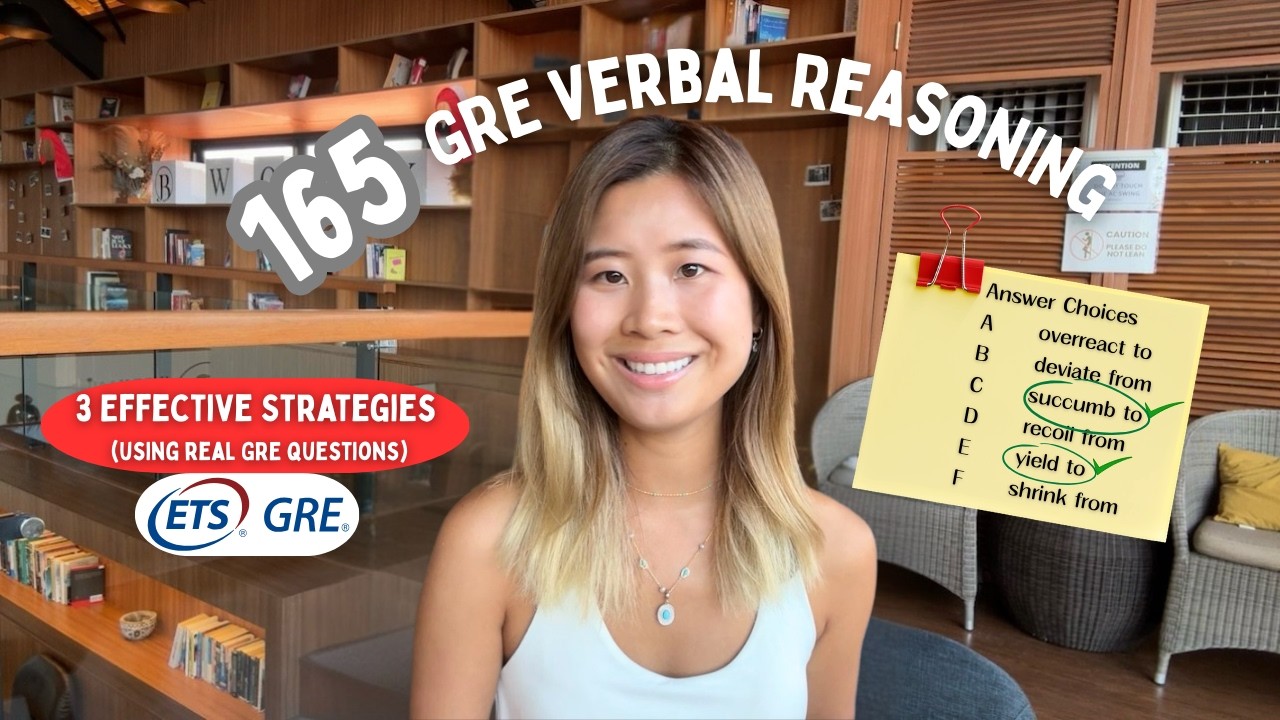
I made a video walking through all three strategies in detail. You can watch it here:
Or keep reading for the full written breakdown with examples, cheat sheets, and the exact methods I used for each question type.
GRE Sentence Equivalence Strategy: Learn Words as Synonym Pairs
Strategy 1Let's start with Sentence Equivalence because this is where most non-native speakers panic. You see a sentence with a blank, six answer choices, and you need to pick the two that both complete the sentence and mean the same thing.
Of course, you need to understand the logic and structure of the sentence. But let's face it: vocabulary is the hard part. I remember looking at practice questions early on and thinking, "Those are words I've never seen in my life, and I don't think I'll ever see them after the GRE."
And I was right. You won't normally come across these in everyday life. Just on the GRE, so here's how to learn them.
Stop learning words individually
Most people grab a GRE word list, start at the top, and try to memorize each word one at a time. Maybe they use flashcards. Maybe they write definitions. That's fine for general vocabulary building, but it's terrible for Sentence Equivalence.
Why? Because this question type doesn't test whether you know what a word means. It tests whether you can spot which two words are synonyms. So you should learn words the same way you'll be tested on them. In synonym pairs.
When you see the word "laconic," you should instantly think "terse, taciturn, reticent." When you see "garrulous," you should immediately connect it to "loquacious, verbose, voluble." Not because you memorized definitions, but because you learned them as a group.
Use the right kind of word list
Most vocab lists are alphabetical, which is basically useless for this. What you want is a GRE equivalent words list that groups words by how they actually appear as answer pairs on the test. I have one in my free study guide that organizes 550+ words this way.
Then it's spaced repetition. Cycle through them over and over. When you get something wrong, write down the synonym pair you missed. Not just the single word. The pair. That's what matters.
If you know the words, you know the answer. Full stop. You stop guessing. You start matching synonyms with confidence.
How this looks in practice
The sentence: "Despite her initial resistance, she eventually the pressure from her colleagues."
Answer choices: (A) succumbed to (B) dismissed (C) yielded to (D) amplified (E) endorsed (F) resisted
How I solved it: The clue word is "despite." That tells me the blank is going in the opposite direction of "resistance." So I need something that means she gave in. I scan for a synonym pair. "Succumbed to" and "yielded to" both mean to give in. They're the match. Done.
The answer: (A) and (C)
I didn't need to carefully analyze each option. I recognized the synonym pair instantly because I had studied them together. That's the whole point.
GRE Text Completion Strategy: Predict Before You Look
Strategy 2Text Completion is where vocabulary meets its limit. There are no synonym pairs to lean on here. Just you, the sentence, and the logic. The words matter, but logic is what makes the difference between guessing and knowing. I like to think of it like baking a cake. You need flour, and that's your vocabulary. But you also need eggs, and that's logic. If you only have flour, you just have a bowl of flour. And that's sad.
Vocabulary is necessary but not sufficient. So here's the method that made Text Completion click for me.
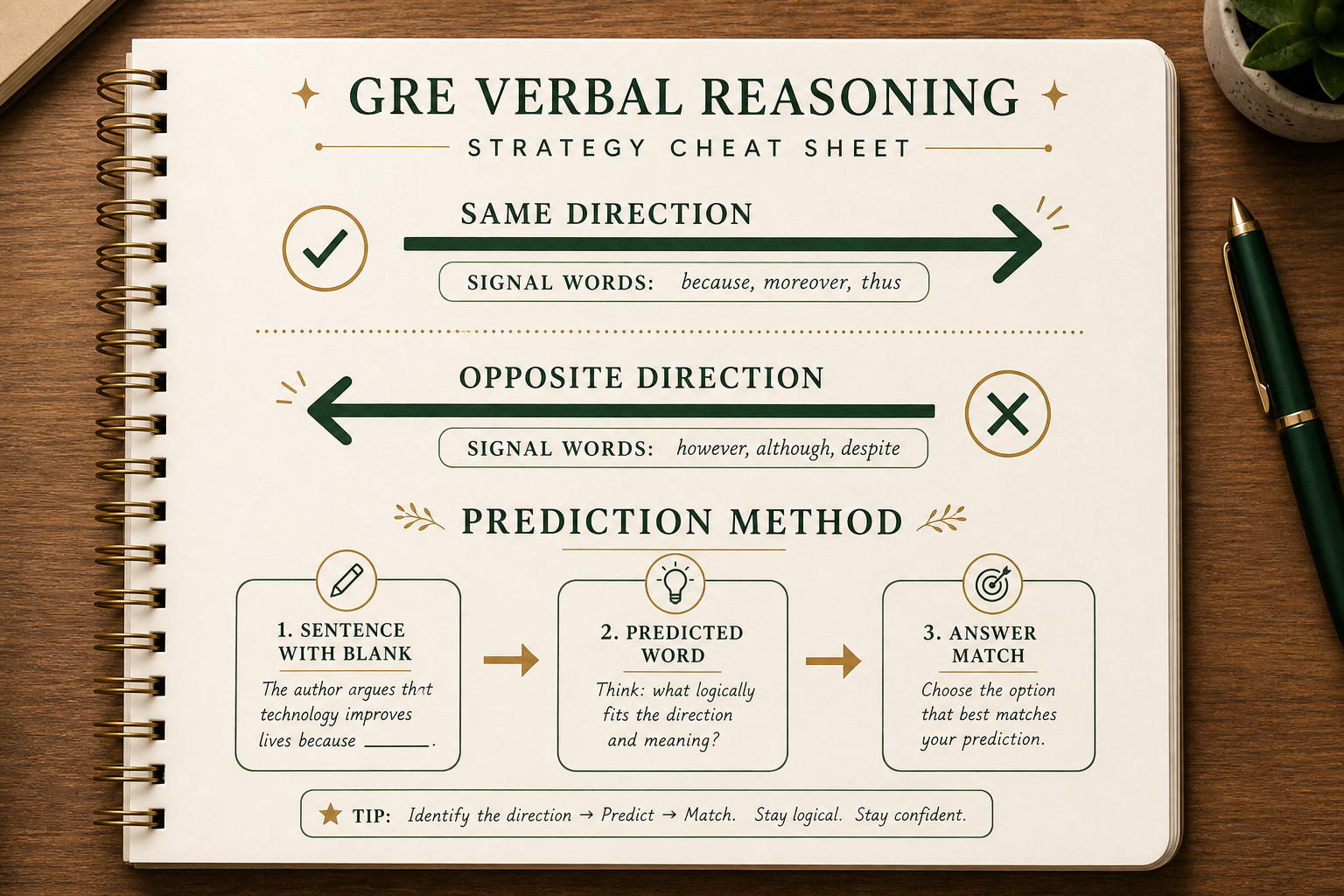
The prediction method
- Read the entire sentence first. Don't look at the answer choices yet. Seriously. Cover them with your hand if you have to.
- Find the clue words. These are the words that tell you the direction of the blank. Words like "though," "however," "but," "moreover," "because," "thus." They're signals.
- Predict your own word. It doesn't have to be fancy. If the sentence says "Although the experiment seemed promising, the results were actually ____," your prediction might just be "bad" or "disappointing." Simple is fine.
- Match your prediction against the answer choices. Now look at the options and find the one closest to your predicted word.
Why this works so well
The answer choices are designed to trick you. ETS puts in options that look right if you're reading quickly, or words that relate to the topic but don't fit the logic. If you go straight to the answer choices and start trying each one, you'll fall for these traps constantly.
But if you've already predicted your word, you're not searching anymore. You're matching. That's a completely different mental task, and it's much harder to get fooled.
Direction clue cheat sheet
These are the signal words you should circle (literally, on the screen, in your head) every time you read a Text Completion question:
Same Direction →
- and
- moreover
- likewise
- consequently
- since
- because
- thus
Opposite Direction ←
- but
- although
- however
- despite
- yet
- nonetheless
- while
"Same direction" means the blank continues the idea that came before. "Opposite direction" means the blank contrasts with what came before. Once you know the direction, your prediction almost writes itself.
Vocabulary is necessary but not sufficient. You also need logic. It's like baking a cake. You need flour, that's vocab. But you also need eggs, that's logic. Otherwise you just have a bowl of flour, and that's sad.
GRE Reading Comprehension Strategy: The Dual-Line Reading Method
Strategy 3This is the one where non-native speakers lose the most time. You read the passage, you think you understand it, you look at the question, and suddenly nothing makes sense. So you go back and re-read. And re-read again. Before you know it, you've spent five minutes on one passage and you're behind on the clock.
I had this exact problem. And the fix wasn't reading faster or reading more carefully. It was reading differently.
Reading is not direct translation
As a non-native speaker, my instinct was to translate every sentence into Chinese in my head, understand it fully, then move to the next one. This is a disaster on the GRE. The passages are dense, and you don't need to understand every word. You need to understand the structure.
Reading comprehension on the GRE is not about absorbing information. It's about streamlining the logic relationships between ideas.
Track two lines simultaneously
Here's the method. As you read each paragraph, track two things at the same time:
- Line 1 (Function): What is the author doing right now? Are they introducing a topic? Contrasting two views? Providing evidence? Conceding a point? Making a conclusion?
- Line 2 (Content): What is the factual information attached to that function?
The key insight is that you only care about content as it serves the argument. If the author spends three sentences describing an experiment, you don't need to memorize the details. You just need to know: "This is supporting evidence for the author's main claim." That's the function. The specific numbers and names are content you can go back for if a question asks about them.
Signal words for reading comprehension
Just like Text Completion has direction clues, Reading Comprehension has signal words that tell you when the argument is shifting. Train yourself to spot these instantly:
| Signal Words | What They Mean |
|---|---|
| however, but, yet | A shift is coming. The author is about to disagree or introduce a contrasting idea. |
| for example, for instance | Supporting evidence. The author is backing up a claim they just made. |
| critics argue, some believe | Counter-argument. The author is presenting a view they may disagree with. |
| thus, therefore, consequently | Conclusion. The author is stating a result or final position. |
The three-step reading protocol
I call this the three-step dance because there's a rhythm to it once you get comfortable. Here's how it works:
Skim the questions first. Just the question stems, not the answer choices. This takes about 15 seconds and tells your brain what to look for. You're not trying to remember them word for word. You're just priming your attention.
First pass: build the function map. Read through the passage once, but only focus on the signal words and the function of each paragraph. Ask yourself, "What is the author doing here?" Don't get lost in details. You're building a mini-map of the argument's structure.
Second pass (if needed): fill in content details. For questions that ask about specific facts, go back to the relevant paragraph. You already know where to look because you mapped the structure. This targeted re-reading is much faster than scanning the whole passage again.
Answer using your map, not the passage. When you answer questions, reference your mental map first. "This question asks about why the author mentioned the experiment. I know that paragraph was providing evidence for the main claim." Then verify with the text if needed.
Most students read like a sponge, trying to absorb every detail. The GRE doesn't test how much you memorize. It tests structure, purpose, and logic.
Once I started reading this way, my reading comprehension accuracy went up and my time per passage went down. It felt counterintuitive at first because I was deliberately ignoring details. But that's exactly the point. You can always go back for details. You can't go back for the time you wasted trying to memorize them on the first read.
Frequently asked questions about GRE Verbal for non-native speakers
How do non-native speakers improve their GRE Verbal score?
The most important shift is treating GRE Verbal as a logic test rather than a language test. Learn vocabulary as synonym pairs rather than individual words. Use the prediction method for Text Completion before you even look at the answer choices. For Reading Comprehension, read for structure and function rather than trying to absorb every detail.
What is a good GRE Verbal score?
A score of 155 to 159 is around the 69th to 83rd percentile. A score of 160 to 165 is around the 86th to 96th percentile. A score of 166 to 170 is in the top 3 to 5 percent. For most competitive graduate programs, 158 or above is strong. Top PhD programs in humanities often expect 163 or higher.
Why do non-native speakers struggle with GRE Reading Comprehension?
The most common mistake is trying to translate or fully understand every sentence before moving on. GRE passages are dense and you do not need to absorb every detail on the first read. Instead, read for the structure and function of each paragraph. Is the author introducing, supporting, contrasting, or concluding? This reduces time spent re-reading and improves accuracy on inference and primary purpose questions.
How many GRE vocabulary words do you need to know?
Around 550 to 600 high-frequency words is a solid target. The more important thing is how you learn them. Group them as synonym clusters rather than individual definitions, because Sentence Equivalence specifically tests your ability to spot which two answer choices mean the same thing.
Want my free study materials?
I put together a free download with everything you need. The day-by-day 60-day schedule I used, plus my GRE equivalent words list with 600+ words organized as synonym pairs. It's more than enough for the entire Sentence Equivalence section.
Or try my free GRE Word Match Trainer to test yourself on 600+ word pairs.